I spent three hours last week watching a founder ask ChatGPT to write his product roadmap.
Three. Hours.
By the end, he had a beautifully formatted document full of generic priorities that could have applied to any SaaS company.
He’d automated the wrong thing.
The Fundamental Mistake Everyone Makes
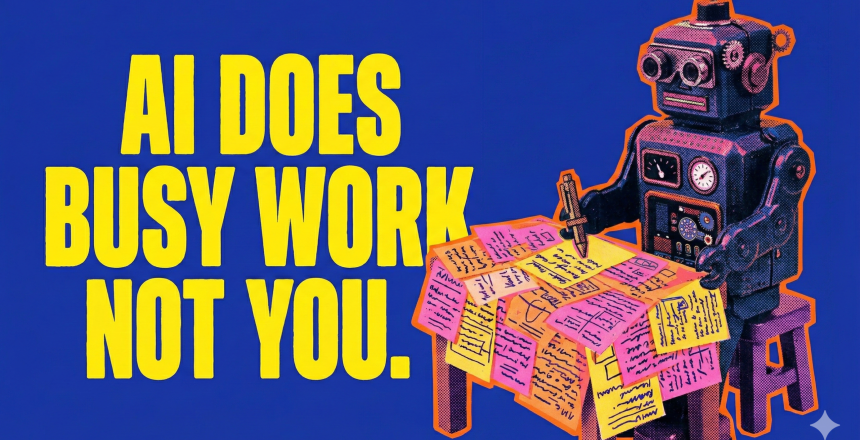
Most founders treat AI like a replacement for their brain instead of an upgrade for their hands.
They ask AI to make strategic decisions. To generate creative ideas. To solve problems that require deep industry knowledge.
But here’s what actually works: AI handles the repetitive tasks that follow your decisions. Your brain makes the decisions that matter.
What Your Brain Does Better
Your brain spent years learning your market. It knows why customers choose your competitor over you. It recognizes patterns in user behavior that data alone can’t capture.
AI doesn’t know that your biggest enterprise client makes decisions differently in Q4. It can’t tell you why your last product launch failed or what your team’s real bottlenecks are.
Those insights come from experience. From conversations. From the messy, non-linear process of actually running a business.
What AI Does Better
AI excels at taking your insights and turning them into execution.
You know your customers struggle with onboarding? AI can draft 12 different email sequences to test, format them for your ESP, and create A/B testing schedules.
You’ve identified three key value propositions for your next campaign? AI can generate 50 ad variations, write supporting blog posts, and create social media content that reinforces those messages.
You’ve decided to restructure your pricing? AI can create comparison charts, FAQ sections, and objection-handling scripts.
The strategy comes from you. The execution gets amplified by AI.
The Division of Labor That Actually Works
I work with founders who’ve figured this out. Their process looks different.
They don’t start with AI prompts. They start with decisions.
Strategy Phase (Human)
- What problems are we solving?
- Who experiences these problems most acutely?
- What makes our approach different?
- Which channels reach our audience effectively?
Execution Phase (AI-Assisted)
- Turn strategy into content calendar
- Create multiple versions for testing
- Format for different platforms
- Generate supporting assets
The human does the thinking. AI does the scaling.
A Real Example
Last month, a founder told me his biggest challenge was explaining why his project management tool was different from the 847 others on the market.
His original approach: ask ChatGPT to write positioning statements.
The result: generic copy that could have described any productivity tool.
His revised approach:
- He spent an hour mapping out the specific failure points he’d observed in other tools
- He recorded himself explaining why traditional approaches don’t work for remote teams
- He used AI to turn that insight into blog posts, case studies, and ad copy
The difference? The revised content felt like it came from someone who’d actually struggled with project management, not someone who’d read about it online.
When to Use Your Brain vs. When to Use AI
Use your brain for:
- Understanding why customers choose competitors
- Identifying which features matter most to users
- Deciding which markets to pursue
- Recognizing patterns in support tickets
- Making trade-offs between speed and quality
Use AI for:
- Turning insights into content at scale
- Creating multiple versions for testing
- Formatting content for different platforms
- Handling routine customer communications
- Organizing information you’ve already gathered
The Productivity Trap
The temptation is to automate everything because it feels productive.
But automating the wrong things makes you less effective, not more.
When you use AI to generate strategy, you’re outsourcing the exact thinking that differentiates you from competitors.
When you use AI to execute better strategy, you’re amplifying what makes you unique.
What This Looks Like in Practice
A founder I know used to spend hours writing individual cold outreach emails. Low ROI activity.
Now he spends that same time researching prospects and understanding their specific challenges. High ROI activity.
Then AI writes personalized emails based on his research. The emails perform better because they’re informed by genuine insight, not generic templates.
Another founder was asking AI to plan her product features. Wrong use case.
Now she uses customer interviews and usage data to decide what to build. Then AI helps create user stories, technical specifications, and rollout communications.
The product decisions are better because they’re based on real feedback, not algorithmic guesses.
Your New Operating System
Think of AI as your execution layer, not your decision layer.
Make the hard choices that require judgment, experience, and intuition. Then let AI handle the work that follows those choices.
Your competitive advantage isn’t having access to AI—everyone has that now.
Your competitive advantage is knowing when to think for yourself and when to let AI amplify that thinking.
Most founders get this backwards. They automate their unique insights and manually handle repetitive tasks.
Do the opposite. Protect your thinking. Automate your execution.
That’s how you stay human in an AI-automated world.