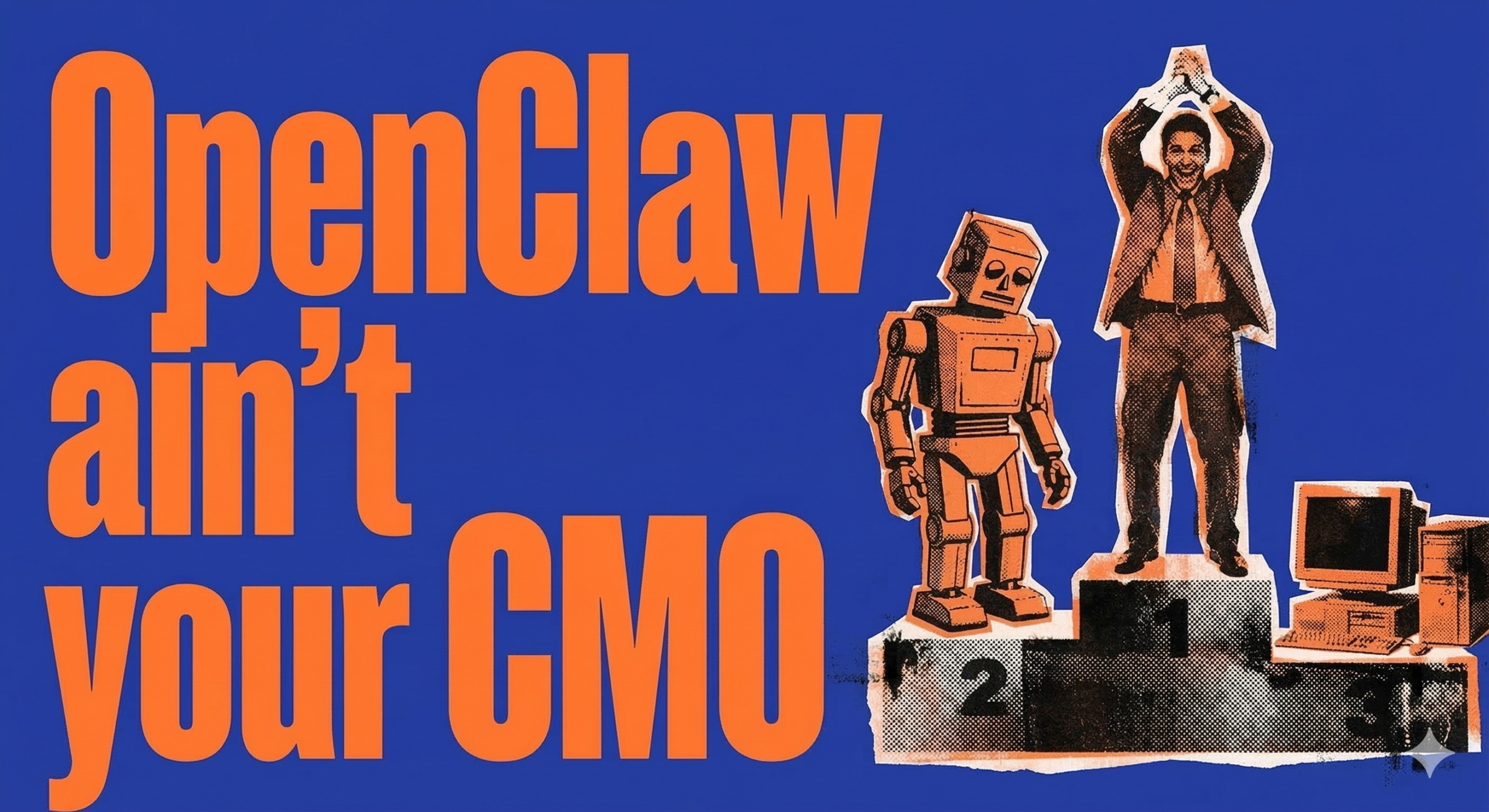
I keep seeing people on X and YouTube saying there’s this skill that replaces their entire marketing team with a $20/month Claude subscription and OpenClaw. You have to understand two things:
- They’re lying to you.
- If you believe it, you’re going to get so much stuff wrong.
I speak here as a tremendous supporter of AI, somebody who has been adding more and more agentic work into my startup, into my agency. I am someone who is as red-pilled on AI automation and the future of work as a human can be. OpenClaw isn’t replacing anybody strategically yet.
There’s a client we work with — I’ll call them ClawCompete — who runs multi-channel paid campaigns across Google Video, Meta, and organic search. They make software in the agentic AI space. OpenClaw competitors, basically. Right in the middle of the hottest category in tech right now.
Every month I run their performance report. Over the last few months I’ve been building a framework to systematize it — a skill file that walks the AI through YouTube attribution, paid social analysis, Search Console correlation, funnel analysis, cross-channel efficiency comparison, and a synthesized set of recommendations.
It’s a good framework. I’m proud of what it produces.
Last month it was almost completely wrong.
What the AI got right (a lot)
The skill catches things I’d never have found manually in a reasonable time.
It flagged that one of ClawCompete’s YouTube videos was racking up views that looked like strong organic performance — until you cross-referenced the Google Ads timeline and realized the view spikes tracked exactly with paid campaign windows and dropped exactly when those campaigns paused. Paid distribution, not organic traction.
Without that check, the report tells the client their content is building audience momentum. It isn’t. The AI caught that before I touched it.
It also ran a proper two-stage funnel analysis. ClawCompete had been frustrated that their Google Video campaign wasn’t converting directly. The AI correctly identified that awareness-stage campaigns aren’t supposed to. They’re supposed to build a retargeting audience for a VSL. That campaign spent about $565, built a usable warm audience, and drove a Search Console impression spike that tripled their baseline. The Meta campaigns in Germany, UAE, and Italy spent four times more and produced neither direct conversions nor a reusable audience.
The AI sorted out which campaign was succeeding at its actual job and which wasn’t. I’d have reached the same conclusion, but it would have taken me three times as long.
So how did it almost get everything wrong?
Where it went sideways
I asked it to analyze a specific short that had blown up in views.
The AI surfaced it as a top organic performer. High view count, decent completion, good signal of audience interest. Recommended building on that content angle.
There were a lot of views. But the spike was too sudden, then too flat. I could see immediately it wasn’t organic.
It was a Meta ad creative hosted on YouTube. The views were paid distribution masquerading as organic signal — an artifact of using YouTube as an ad hosting platform, nothing more.
Once I flagged it, the AI updated correctly and actually strengthened the argument: the real organic performer was a different Short, one about OpenClaw’s security implications, sitting at 185% average viewed. People were rewatching it. Zero ad spend. That’s the kind of signal that tells you what to run next.
The AI got there because I knew what to look for. I’ve been in marketing long enough to know that view timeline shapes don’t lie, and that paid-distribution-dressed-as-organic is the most common error in video reporting. Without that pattern recognition, I don’t push back. And neither does anyone who isn’t a senior operator.
The instruction problem is worse than the analysis problem
When the report went sideways, the AI didn’t make an analytical error. It’s genuinely good at analysis once it knows what to analyze.
The problem is that it will analyze exactly what you tell it to analyze. Frame the question wrong and you get a precise, confident answer to the wrong question.
Ask “how is this video performing?” and you get an answer about the video. You don’t necessarily get an answer about whether those are paid views or organic, whether the campaign was designed to convert or to build an audience, or whether the comparison you’re implying between channels is even a fair one given how they were structured.
You have to already know to ask those questions. That knowledge doesn’t live in a skill file. It accretes from watching reports fail.
The AI executes analysis well. It doesn’t know which analysis to execute. That’s a different competency, and it lives in the person running it.
OpenClaw changes the speed, not the expertise requirement
Agentic AI is genuinely impressive. Multi-step workflows, chained tool calls, outputs without handholding — this is where I’m pushing hard, both inside CrowdTamers and with clients.
But agentic execution makes the instruction problem worse, not better. A model running a 20-step reporting workflow doesn’t produce one wrong answer when the framing is off at step 2. It produces a coherent, confidently formatted wrong report — all 20 steps executed flawlessly in service of a bad premise.
This is where the “AI replaces your marketing team” crowd loses the thread. An AI can do junior analyst work at 10x the speed. That’s real value. What it can’t do is notice the errors it’s making.
A CMO isn’t valuable because she can run a report. She’s valuable because she knows when a report is lying. That’s not a skill you train in a prompt. It’s pattern recognition built from a hundred reports that turned out to be wrong for reasons that weren’t visible at the time.
The AI I use every day is excellent. It caught the paid-vs-organic misattribution before I did. It built a cross-channel efficiency comparison I’d have spent hours on. It flagged a funnel drop-off with more precision than most analysts would.
And it almost sold me a confabulated organic signal as real performance data, because I hadn’t framed the question quite right, and it had no way to know that.
What “human in the loop” actually means
I’ve been sharpening the reporting skill through sessions exactly like that one. Every time I push back and find a better frame, that frame goes into the skill. It’s better now than it was three months ago.
But that improvement loop only runs because a human is in it. The skill gets better because I notice when it’s wrong. Noticing requires knowing what right looks like.
If you’re building an AI-assisted marketing operation — agentic workflows, prompt chains, whatever the stack — don’t invest in removing human oversight. Invest in making it faster. AI does the lifting. A human checks the premise.
The companies that get this wrong will fire their marketing director and spend six months wondering why their AI-generated reports are so consistent and so useless.
The ones that get it right will use AI to give that director ten times the surface area, and trust her to know which numbers are lying.