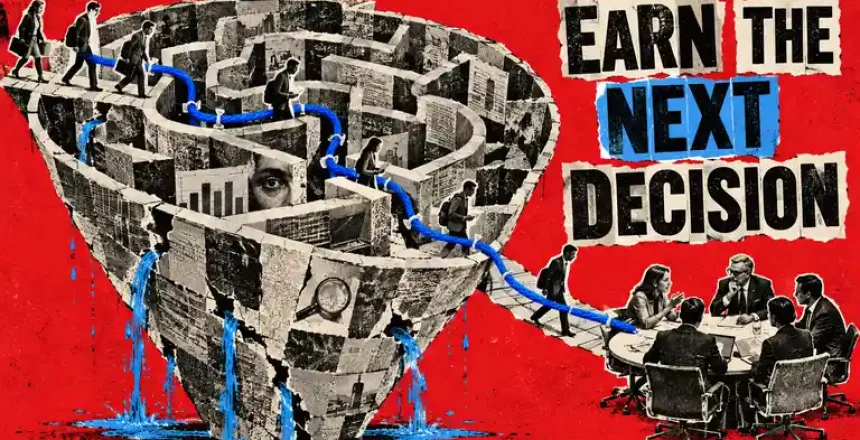
Build your B2B growth marketing strategy around one job: make the next buyer conversation easier to earn. A channel plan is just inventory until it does that job.
That distinction matters because buyers can learn a lot about you before they ever talk to sales. They search, compare, forward links, argue internally, and look for proof that your company understands the problem they’re trying to solve. If marketing treats every click as a hand raised for a demo, it turns early curiosity into unwanted pressure.
That handoff breaks when a buying group is still forming an opinion and the person filling out the form can’t make the decision alone. Research on B2B buying decisions keeps the unit of analysis where it belongs: the group, not the form fill.
Start with the decision you need to earn
Most growth plans begin with a channel list. LinkedIn. Search. Webinars. Paid social. Those are tools, and they only matter once the commercial decision is clear.
Start with the commercial decision instead. Which account type needs to change its mind? What does the person who feels the pain need to show the person who owns the risk? What question has to be answered before a sensible next step becomes possible?
That work gives you a real job for each asset. A founder video can make a hard tradeoff understandable. A search page can answer the question a buyer’s already asking. A landing page can turn that understanding into a low-friction action. An outreach message can point to the evidence instead of pretending the recipient’s been waiting for a meeting.
Strategy-first marketing means making those decisions before you select the distribution mechanism. Otherwise the campaign gets optimized around what is easiest to count, and the buyer gets a sequence that feels like it was assembled by different companies. You don’t need to make the system more complicated. You need to make it cohere.
Give the buying group something useful to carry internally
A buyer doesn’t need more generic content about your category. They need material they can use when somebody else asks, “Why this, and why now?”
That’s where founder content earns its keep. It can name an uncomfortable tradeoff, explain the failure mode behind an apparently sensible choice, or make a claim that a product page can’t carry on its own. The point isn’t to make the founder a content machine. The point is to capture the judgment that already shows up in sales calls, customer conversations, and product decisions, then turn it into something a prospect can examine without booking time.
Our founder content strategy work is built around that principle. Capture one useful conversation, find the thought with some teeth in it, then adapt it to the question each channel is asking. The video, article, email, and ad shouldn’t be copies of one another. They should give the same underlying idea a different job. You’re not publishing to fill a calendar.
This also gives paid media a better destination. A click to a vague “learn more” page is cheap theater. A click to an argument that helps a buyer explain a decision internally can create the familiarity that makes later conversion possible. Edelman and LinkedIn’s B2B thought leadership research is worth reading for the same reason: thought leadership is part of how buyers assess a supplier before the sales process is fully underway.
Test the connection, not the click
Growth teams still spend a lot of time congratulating themselves for a number that sits too close to the ad platform. Click-through rate, cost per lead, and form completion rate can be useful diagnostics. They don’t settle the question when the sales team can’t turn the resulting activity into qualified conversations.
Write down what must change before you launch. You might be testing whether a specific point of view earns more visits from a target account list, whether an article-assisted visitor is more likely to accept a follow-up, or whether a new landing-page explanation improves the quality of booked calls. Then hold enough of the system still that you can tell what caused the result. If you can’t say what decision the test will change, don’t run it yet. You won’t get a clean answer by changing the question halfway through.
Google’s experimentation playbook is a solid reminder that a test needs a stated decision, a comparison, and a way to avoid mistaking noise for proof. That discipline applies to creative and offers as much as it applies to media budgets. If every variable changes at once, the team has produced activity, not learning.
Attribution still has a role, but it shouldn’t be allowed to tell the whole story. A buyer may watch a video, search later, read a comparison page, and submit a form through branded search. The final click is evidence of timing, not necessarily the full cause of demand. This B2B SaaS attribution discussion is a useful prompt to inspect the chain of interactions rather than rewarding only the last one.
Build a loop that can get smarter
A usable B2B growth marketing strategy has a loop: listen for the words buyers use, make a clear argument around the consequential question, distribute it where that question already exists, and judge the result against pipeline evidence rather than applause.
It won’t run perfectly in month one. It should get more specific. Sales objections should sharpen the next piece of content. The questions that bring the right visitors should change the next landing page. The experiments that produce qualified movement should earn more spend, while the rest don’t.
That’s the loop the channel plan was supposed to serve. Make it visible, and marketing stops asking buyers to trust a handoff they haven’t had time to believe in.