Most B2B SaaS go-to-market strategies fail because you throw everything at the wall, assume something sticks, and have 3 smart, busy people who work hard and don’t move the needle.
What a waste.
That usually looks like this: paid ads are running, sales is doing outbound, somebody’s writing blog posts, and the product team’s pushing a free trial. Every dashboard’s got movement. Nobody can say which motion’s turning a specific problem into qualified pipeline.
A good B2B SaaS go to market strategy gives you a stop-and-scale system. Pick a buyer, a painful trigger, an offer, and one motion. Run the test. Keep the channel that’s producing qualified progress. Stop the activity that’s getting attention without movement.
That isn’t as exciting as launching everywhere at once. It works better.
The hard truth about most B2B SaaS go-to-market strategies
The first 90 days shouldn’t be about balanced coverage. They’re about finding one repeatable path from a specific trigger to a qualified conversation.
Before you add another channel, you’ve got to define five things:
- Segment: Which kind of account feels this problem often enough to act?
- Buying group: Who feels the pain, influences the decision, approves the budget, and signs?
- Trigger: What happened that makes the problem urgent now?
- Offer: What outcome can the buyer understand without sitting through a product tour?
- Motion: Does this account need a trial, a guided evaluation, or a sales-led process?
Then define the event that earns the next dollar you’re willing to invest.
A post that gets attention but produces no relevant conversations may have an interesting idea and a weak commercial connection. Outbound that creates meetings which never reach evaluation has a problem with the offer, not the subject line. A trial that attracts signups but fails to get users to the first useful outcome doesn’t need more traffic yet.
My operating rule: scale a motion after it creates qualified conversations repeatedly at an acquisition cost the business can support.
A clear ICP without a painful trigger is just targeting. More gated content won’t repair it, and more outbound won’t prove pricing. This B2B prospecting playbook is useful for structuring the manual work before you automate it.
Why B2B SaaS buying needs a different strategy
A B2B SaaS buyer’s rarely one person moving through a tidy funnel. The practitioner may discover the problem. A functional leader may sponsor the purchase. Finance may challenge the business case. Security may block the deployment. The contract signer may never use the product.
Gartner’s 2024 B2B buying research, as summarized by The Starr Conspiracy in 2025, found that 77% of B2B buyers described their latest purchase as complex or difficult. The same benchmark review puts the median enterprise SaaS buying group at 11 stakeholders. Those figures are useful as a warning, not as a universal planning assumption.
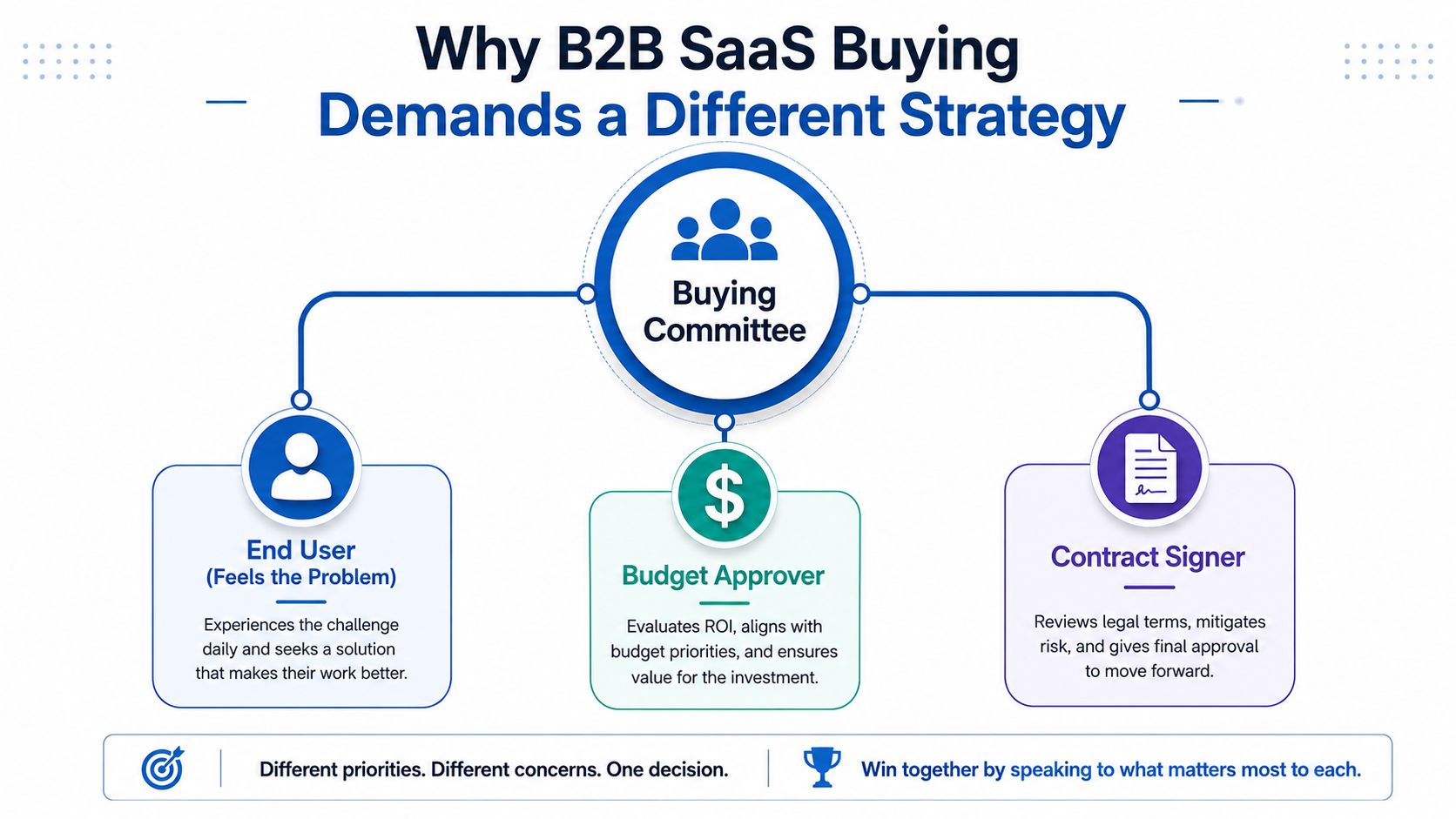
That changes what conversion means. The landing page’s got to help the end user see the cost of the status quo, give the operator a credible way to evaluate the product, and give the executive enough material to defend the spend.
Build around progression, not handoffs
Teams lose the thread when they design around departments instead of buyer decisions. Marketing celebrates a lead. Sales treats every trial as a demo opportunity. Product measures activation without checking whether the account’s got the right people.
Map every stakeholder to an objection and a progression event:
- End user: Can they reach the first useful outcome?
- Functional owner: Can they explain implementation, workflow, and expected impact?
- Economic buyer: Can they defend the spend and timing?
- Security and legal: Can they clear the risk and contract requirements?
- Signer: Is the proposal specific enough to approve?
Harvard Business Review Analytic Services found a 45-point gap between the importance of go-to-market execution and its effectiveness. Eighty-three percent of respondents called GTM strategy very important, while 38% rated execution very effective, according to the LeanData summary.
Every motion should create evidence that more of the buying group is moving forward. This GTM guide for technical founders covers the same problem from the product side.
Use pricing experiments to test the funnel
Pricing tests fail when the team treats them as a contest between two numbers. Start with the offer. Then you’ve got to test the package, the price, and the terms.
A weak promise makes a reasonable price look expensive. Confusing packaging makes a valuable product feel risky. Changing the number first hides both problems.
Test the offer before the price
Compare an outcome-led headline with a feature-led version for matched audiences. The pass signal is qualified conversion, not clicks or raw signups.
Then compare a starter package with a guided package that includes implementation help. Look for stronger activation and a shorter route to first value. If the guided package raises engagement but creates an unprofitable service burden, you haven’t found a winner. You’ve found a delivery trade-off that needs a boundary.
| Test | Example | Pass signal | Fail signal |
|---|---|---|---|
| Offer | Outcome-led headline versus feature-led headline | More qualified conversations | More clicks without progression |
| Packaging | Starter plan versus guided implementation | Better activation and faster first value | More support without stronger intent |
| Price | Lower versus higher price in one segment | Purchase intent supports the economics | Win rate or cycle quality weakens |
| Terms | Monthly access versus annual commitment | Stronger commitment without damaging fit | Buyers delay or object to the structure |
A 20% signup lift can still be a losing result if the new cohort’s got weaker purchase intent. Review sales objections, lost-deal notes, activation events, refund reasons, and the sales effort required before you call a test successful.
Unbounce’s analysis of 41,000 landing pages, 464 million pageviews, and 57 million conversions reported a 6.6% median conversion rate across industries and 3.8% for SaaS pages. The figures come from a broad benchmark, so use them as context rather than a target for your own funnel.
Don’t call a pricing winner until it produces more qualified pipeline per unit of effort.
Trial versus demo: use deal complexity
The trial-versus-demo decision gets clearer when you look at deal complexity and annual contract value together. You can’t use either one on its own.
A self-serve trial works when a practitioner can reach value quickly, setup is contained, and the buyer can approve the purchase without coordinating a committee. A demo works when the product touches another team’s data, requires architecture decisions, or needs a champion to defend a budget request.
There isn’t a universal ACV threshold. A low-value product can need a demo when setup risk is high. A high-value product can support a trial when it’s easy to understand and the user can prove value without help.
| Attribute | Trial wins when | Demo wins when |
|---|---|---|
| Value moment | The buyer reaches meaningful value quickly | Value depends on configuration or consultation |
| Buyer | A practitioner can start and approve | A champion needs executive, security, or finance support |
| Deployment | Setup stays inside the user’s workflow | Deployment affects systems, permissions, or teams |
| Main leakage | Users stall before activation | Prospects disappear during procurement |
| Success signal | Qualified accounts reach the value event | The buying group advances to evaluation |
Use a hybrid when complexity has two levels
A product-led trial can stop at a feature ceiling and invite a sales conversation when the account needs advanced permissions, integrations, or team-wide deployment. A prospect can also enter through a guided demo and receive a sandbox to validate the workflow without another meeting.
Don’t route every account through both motions. Define the switch with behavior you can see: repeated use across teams, an enterprise feature request, a security review, or a request for commercial terms.
For another look at reducing friction in B2B selling, read this guide to redesigning the minimum viable ask.
Founder-led content gives the motion a memory
Founder-led content can be the best awareness investment available. The reason’s repetition. Buyers see the founder make the same sharp point several times, and the company starts to stand for one problem instead of a collection of features.
That matters when buyers use search engines, review sites, and AI assistants to build shortlists. Familiarity doesn’t close the deal. It makes the later conversation less cold.
The subject matter should come from discovery calls, lost-deal notes, onboarding friction, and customer questions. “Our platform has flexible workflows” is a product statement. “Most RevOps teams don’t have a lead problem. They have an ownership problem between intent and follow-up” is a point of view.
Make content feed the revenue system
Each strong idea should produce a founder post, a short video, a paid hook, an outbound opener, and a sales follow-up asset. That gives the buying group shared language without pretending every stakeholder needs the same message. You don’t need five unrelated campaigns.
CrowdTamers helps B2B founders turn monthly founder interviews into short-form videos, written posts, and paid creative. The operating requirement stays the same whether production is internal or outsourced: publish a clear point of view, watch which audiences create qualified conversations, and retire ideas that earn attention without commercial movement.
Scale paid acquisition in learning cycles
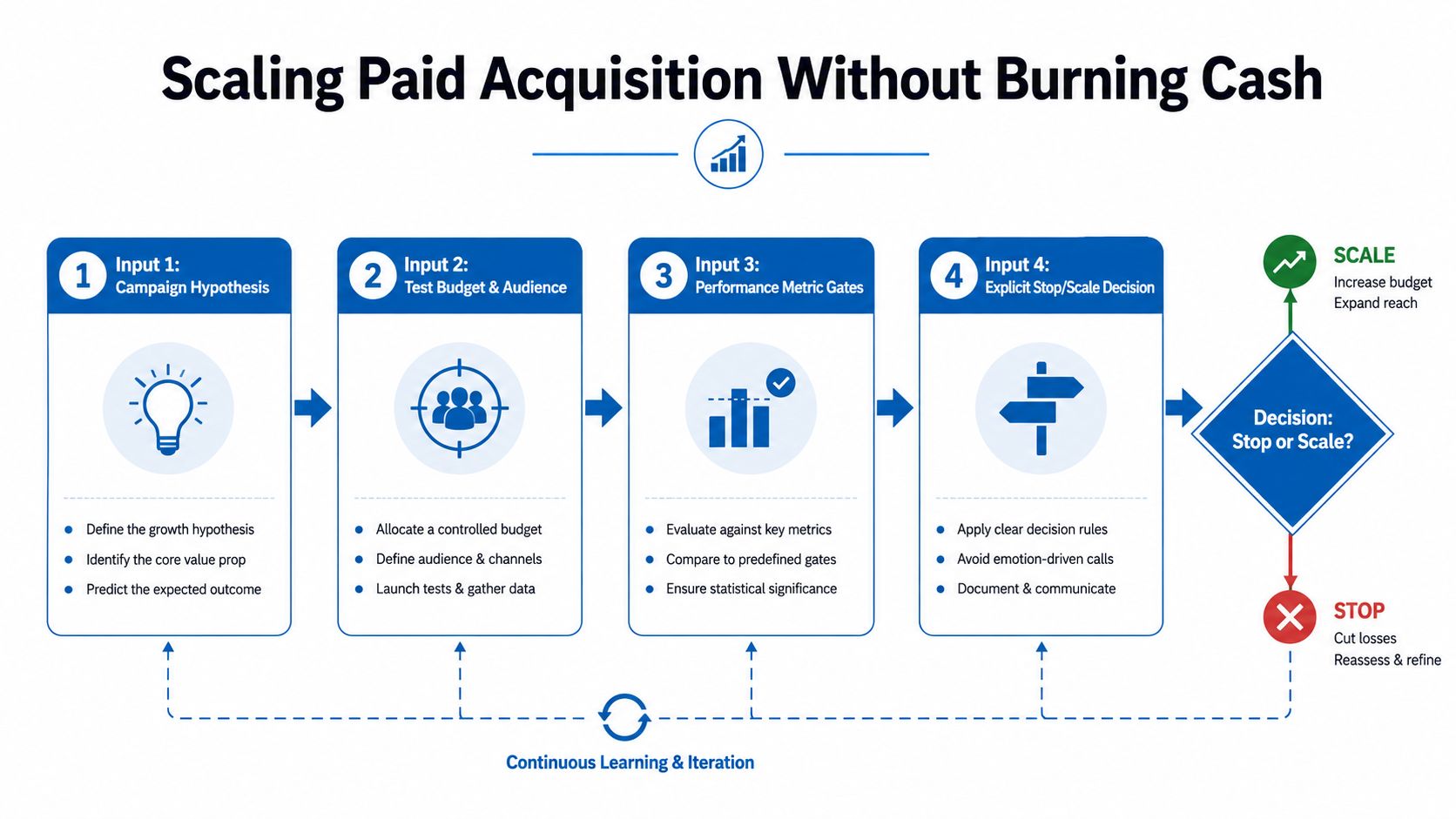
Paid acquisition should run in three-to-five-month learning cycles, not through endless small budget increases. Each cycle needs a guess, a test budget, an audience, a creative plan, and a stop-or-scale decision. If you can’t state the decision, you’re buying activity.
Track four things:
- CAC payback: Compare acquisition cost with a recovery ceiling the business can support.
- Pipeline coverage: Check whether sourced and influenced pipeline can support the revenue target.
- Creative velocity: Count new hooks, not cosmetic ad variations.
- Signal quality: Judge qualified demos, trials, and buying-group progression.
Reallocate after the gate clears
When a channel clears its payback and coverage thresholds for two consecutive months, move 20% to 30% of spend from the weakest channel into it. Those figures are an operating rule, not a market benchmark.
Set a monthly cap for every channel during its learning phase. Tie the kill condition to demo quality or trial progression, not clicks. A campaign with inexpensive clicks and poor-fit accounts is still bad acquisition.
The logic behind paid and organic growth working together applies here. Founder content can supply the hooks. Paid distribution can test which audiences respond commercially.
The answer-engine layer most GTM plans miss
More gated ebooks and more outbound won’t solve a discovery problem if buyers are forming shortlists inside AI assistants, comparison engines, and internal copilots.
G2’s 2025 buyer-behavior research reported generative AI chatbots as the top source influencing vendor shortlists at 17.1%, ahead of software review sites at 15.1%, according to Business Wire.
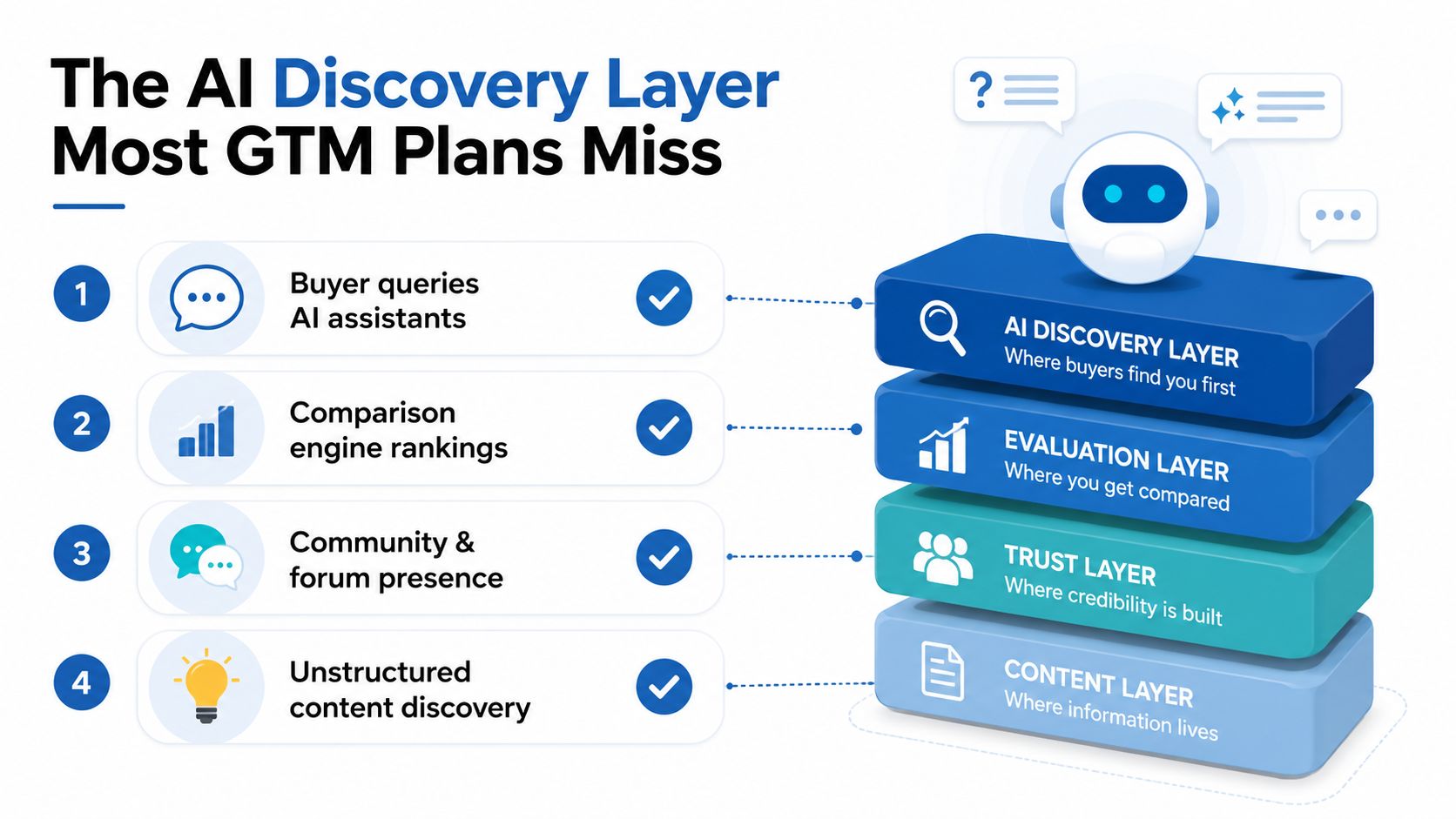
Traditional SEO still matters. The format of useful evidence is changing, though. An article can rank and still fail to appear in a generated shortlist if it doesn’t say who the product’s for, what it replaces, how it connects, or where it isn’t a fit.
Publish evidence assistants can use
- Comparison pages: State differences against named alternatives with support for the claims.
- Product facts: Make pricing, integrations, deployment options, and limits easy to find.
- Customer stories: Explain the problem, action, and outcome in plain declarative sentences.
- Entity clarity: Use consistent names for the company, product, category, founder, and integrations.
- Discovery monitoring: Ask major models how they describe the category and record what evidence is missing.
Generic content with a few added keywords won’t do this job. Buyers and assistants need evidence they can use.
A 90-day B2B SaaS go-to-market plan
Every block in the plan needs an owner, an artifact, and one decision metric. Without those things, “test pricing” and “improve conversion” survive as tasks without producing a decision. That’s how a calendar fills up without a GTM system.
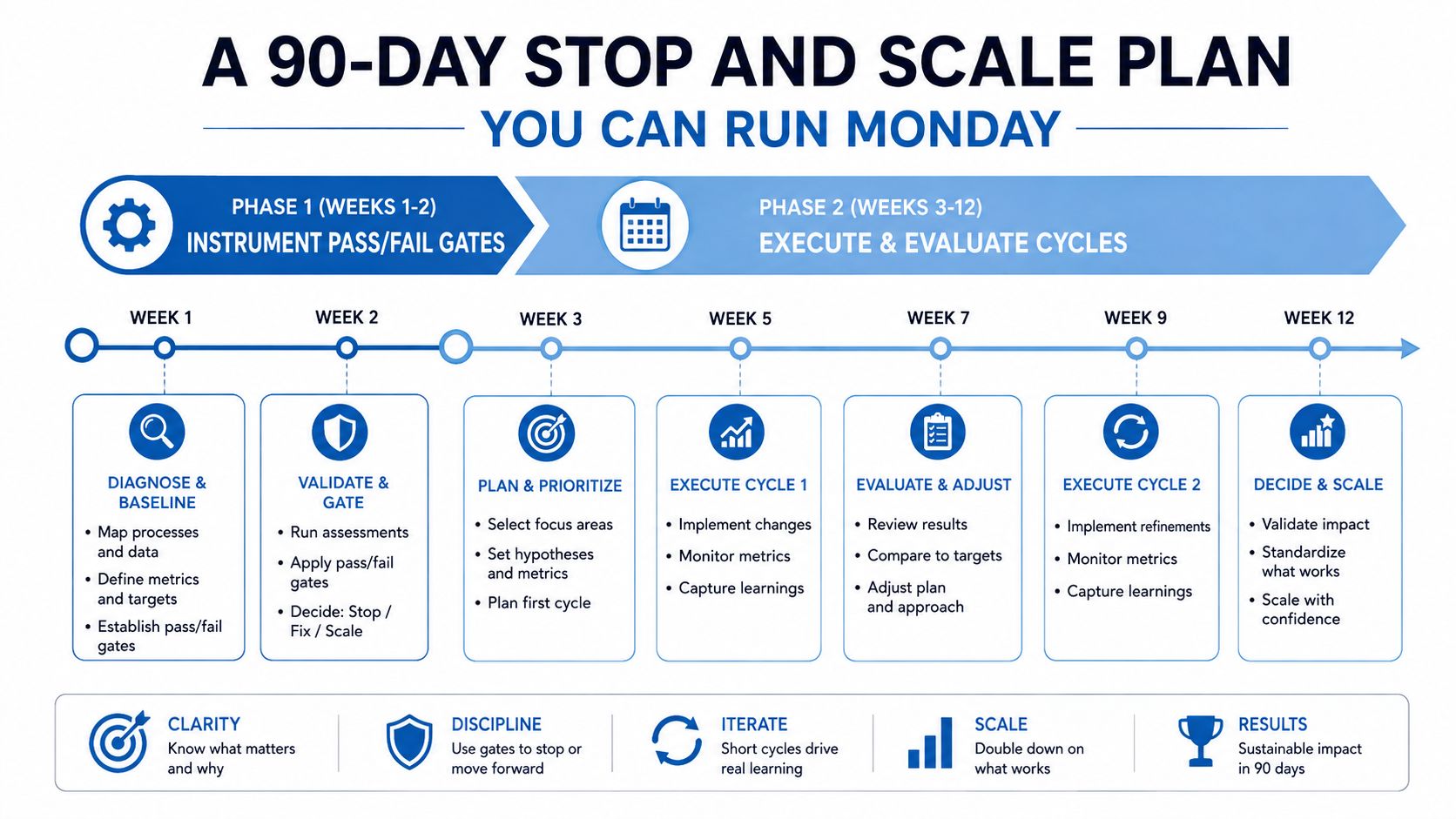
Weeks one and two
Instrument the funnel before changing it. The founder owns positioning and content. Sales owns stage definitions and follow-up. Product owns activation and time to first value. Finance or operations owns acquisition cost and payback.
Create a pricing test brief, a trial-versus-demo routing rule, a buying-committee map, and a content tracker. Measure qualified progression, meaning the account reaches the next stage with the right buying participants.
Weeks three through six
Run the offer and packaging tests, split trial and demo motions by deal profile, and publish the founder point of view consistently. Each post gets one audience problem and one intended conversation. Sales should tag objections by stakeholder so product and marketing can separate product friction from commercial friction.
Use HubSpot, Pipedrive, or a disciplined spreadsheet if the team won’t maintain a larger system. Measure qualified pipeline created per unit of sales effort.
Weeks seven through ten
Scale the paid channel that clears its gate, stop the one that doesn’t, and publish the comparison pages, product facts, customer narratives, and discovery notes that help buyers evaluate the company.
Weeks eleven and twelve
Consolidate the evidence. Reset the baselines. Document the winning message and buying group. Close the weakest funnel leak, then queue the next learning cycle.
Operator’s test: If nobody can say what gets stopped, what gets scaled, and who decides, the company has a list of activities. It doesn’t have a go-to-market system.
CrowdTamers helps B2B founders turn founder expertise into short-form thought leadership, paid distribution, and measurable funnel experiments. Visit CrowdTamers if you need help building a go-to-market system around your offer, audience, content, and qualified pipeline.