Your next growth dollar should pay for a buyer to take a specific next step. A go-to-market (GTM) strategy coordinates who you sell to, what you offer, how buyers find and evaluate it, and what happens after they buy, so you can see where another channel would help and where it would just add work. That’s the useful answer to what are GTM strategies: a set of connected commercial choices you can test. For a B2B startup, the practical version fits on a page with eight decisions, a buyer path and rules for spending more. Start there. You can buy traffic while the path is broken, but the traffic won’t tell you which handoff you forgot to build.
Write the eight decisions before choosing channels
The first four decisions are your target customer, their problem, your positioning promise, and your offer with its price. Write each in terms a buyer could recognize. A controller trying to reconcile vendor invoices has a different job from a finance executive looking for a new planning system, even when both work at the same company. Name the painful workflow, the alternative they’re using and the reason your approach deserves a look. If you need help with that last part, compare with competitors against the buyer’s actual decision. Then say what they’re being asked to buy and how you’ll charge. An offer with no clear starting scope leaves the buyer to invent the risk.
The remaining four decisions are acquisition channels, sales process, ownership, and success metrics with stop-or-scale rules. Where will you reach this buyer? What must happen between their first reply and a purchase? Who follows up, and who can stop spending when the test fails? Write down names. Choose a meaningful outcome, such as a conversation with a buyer who fits your criteria, and decide what evidence would justify the next investment before anyone starts reporting clicks as progress or explaining away replies from people who’d never buy. Filling in eight rows proves nothing. You’ve made your guesses visible enough that someone can challenge them before you fund them.
Match the GTM motion to the buying work
Product-led and sales-led strategies put different amounts of work on the product and the people selling it. A product-led route makes sense when users can try a useful workflow themselves, understand what they’ve gained and take the next buying step without extensive help. You’ll still need to handle setup, support and the point where a team wants broader approval. A sales-led route can handle discovery, technical review and a negotiated agreement, provided the deal can support the cost of that human time. Ask what buyers must do before they can trust the purchase, which work your product can genuinely let them do alone, and whether your team can support the people who need help before they’ll agree to spend. Speed isn’t a buying process.
Founder content can help buyers judge how you think about their problem. Partnerships can put an offer inside a distribution network buyers already use, if the partner has a reason to support it. A community needs useful exchanges between members and someone willing to maintain it. Paid acquisition lets you test a message and offer with a defined audience, but a click doesn’t settle whether the offer is worth buying. These approaches can support one another. Start with a primary route you can explain and resource, rather than assigning your small team six separate growth jobs. Fetchin’s B2B demand generation tactics offer further channel ideas once you’ve decided which buying behavior you’re trying to serve.
Make the handoffs part of the strategy
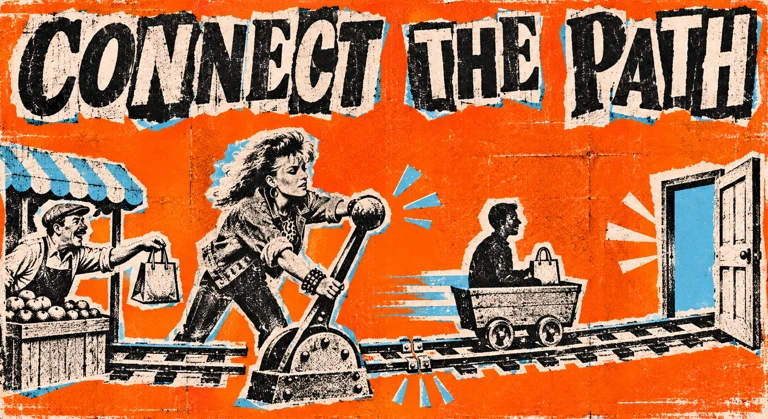
Follow one buyer from discovery through qualification, purchase, onboarding and the decision to stay. The founder’s video might explain the problem, the landing page might show the offer, and a call might establish fit. Each step needs to carry the same underlying promise while adding the proof the next person needs. A finance approver may ask about costs that the first user never raised. Who follows up? Our sales funnel optimization guide looks more closely at where qualified interest stops moving. Keep following the path after the contract, too. If onboarding can’t deliver the value you sold, winning more contracts will create more disappointed customers.
Work through a fictional invoice tool
Suppose you’re building an invoice reconciliation tool for controllers at B2B companies with 50 to 200 employees. This is a fictional example, and manual invoice matching is your problem hypothesis, not a finding you’ve already earned. You’d first ask controllers how they handle that work, where it stalls and whether fixing it deserves a budget. Your initial offer might be a paid pilot covering one agreed workflow, with a price, a baseline and success criteria agreed before it starts. That gives the buyer a bounded decision. It also gives you a way to learn whether the product helps, without claiming that you’ve already cut the month-end close to a number you haven’t measured.
Now compare two possible messages, one about closing faster and another about reducing manual matching, while keeping the offer and buyer definition stable enough that a change in response gives you something useful to investigate. Change everything and you’ll learn less. Before launch, decide what makes a conversation qualified: does the controller have this workflow, want to change it and have a credible route to approving the pilot? Record what they say and whether they take the agreed next step. Don’t announce a winning message because it attracted the cheapest clicks. And ask how buyers found you rather than assuming every conversation came from the last ad they saw. A handful of interviews can suggest where to test next. They can’t tell you how the whole market buys.
Set the stop and scale rules before spending
Your first test brief needs a buyer definition, message, offer, channel and destination, along with the action you’ll count as success. Set a review date, a minimum amount of evidence you’ll collect and a loss limit you can afford. Give someone pause authority. For the fictional invoice tool, you’d watch the cost of qualified conversations and their progress toward a pilot, while recording objections that explain why the offer stalls. Set thresholds from your own economics and sales cycle. Early B2B results may be useful directional evidence even when they’re too sparse for a reliable claim of conversion lift. Treating them as a reason for another bounded test is different from calling the channel proven.
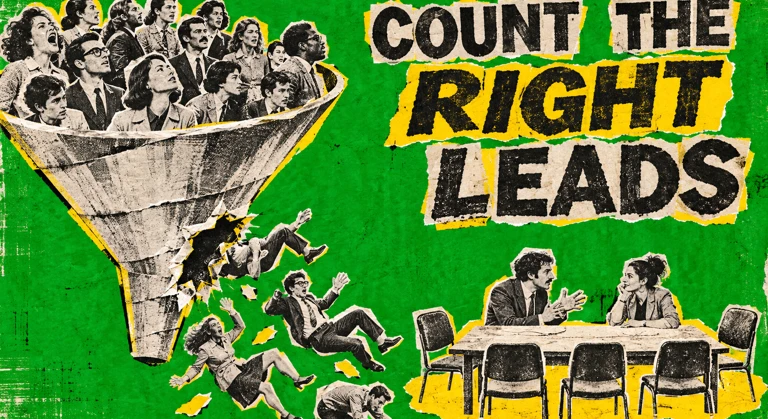
When results disappoint, locate the stalled step before changing everything. Wrong-fit replies point you toward the audience or promise. Suitable buyers who won’t try the offer give you a different question about value, scope or risk. Buyers who agree to a meeting and then disappear may need a better follow-up or a clearer next decision. Check the records rather than diagnosing from a headline metric, and allow time for the sales cycle before treating open opportunities as lost just because they haven’t closed by the date you wanted to present a result. The strategy is still open to revision. You need enough evidence to say what the next dollar will test, who will act on it and which buyer step it should make easier.