
YouTube Shorts can be a good growth channel and a poor revenue channel at the same time. That's the counterintuitive answer B2B founders need, because the format's value usually shows up in reach, repeat exposure, branded search, and assisted conversions, not in direct ad payout. The reason for this post is simple, Shorts has become large enough to influence demand generation decisions, but too many “is YouTube Shorts worth it” takes still judge it like a monetized creator product instead of a B2B funnel lever.
Introduction With Bottom Line Up Front
For B2B founders, YouTube Shorts is worth testing when the goal is awareness, problem framing, and repeated founder-led exposure. It is often not worth it if you expect ad revenue to pay back the work by itself. The business case has to come from pipeline influence, not creator economics.
Shorts now operates at internet scale, and that changes the math for demand generation. It reaches a huge audience, but reach alone does not prove commercial value, especially for channels that need qualified attention rather than broad entertainment traffic.
The decision matters because Shorts can help buyers recognize your point of view faster, yet it can also waste effort if every clip is treated like a standalone asset. For B2B teams, the better question is whether the format moves prospects closer to trust, search, and action. Measured that way, Shorts can be useful.
Understanding YouTube Shorts Scale and Mechanics
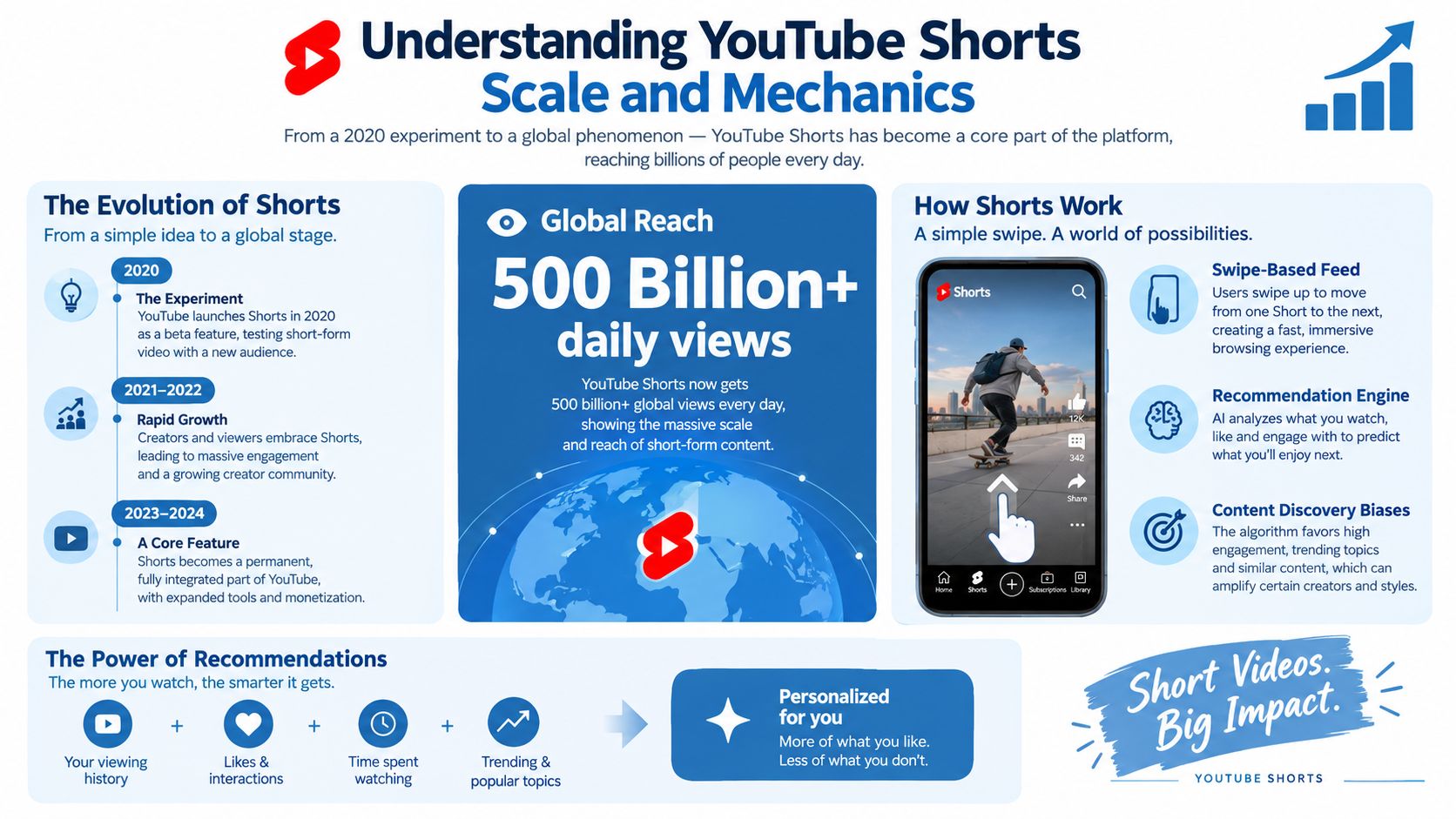
Shorts is no longer an experiment at the edge of YouTube. It now works as a distribution layer with enough traffic to create repeated exposure, which matters for founder-led brands because familiarity builds faster when the same point of view appears often. Reports cited by Teleprompter describe Shorts as reaching mainstream scale, not narrow niche usage, and that changes how B2B teams should judge the format.
Why the feed behaves differently
The Shorts feed is swipe-based, so the opening seconds carry more weight than context, setup, or brand history. That design favors immediate hooks and fast comprehension, which is why a clear founder explanation can outperform a polished clip that opens slowly. Research published on arXiv found that short-form content can generate more engagement than long-form content, and that channels adding Shorts later saw lower long-form engagement on the same channel (arXiv). The takeaway is direct, Shorts can extend reach, but it needs a specific job in the funnel.
Practical rule: use Shorts to create quick recognition, not to carry the entire argument.
The feed also tends to reward content that gets fast interaction and repeat consumption. Broader analysis suggests that joyful or neutral clips, along with videos already showing traction, often have an easier path to distribution than niche educational material (AllOutSEO). For a B2B founder, that does not make Shorts a poor fit. It means packaging discipline matters as much as the message itself.
A practical way to produce clips faster is to create YouTube Shorts with AI, especially when one founder interview needs to become several short assets without rebuilding the message from scratch.
Assessing ROI Metrics for B2B Demand Generation
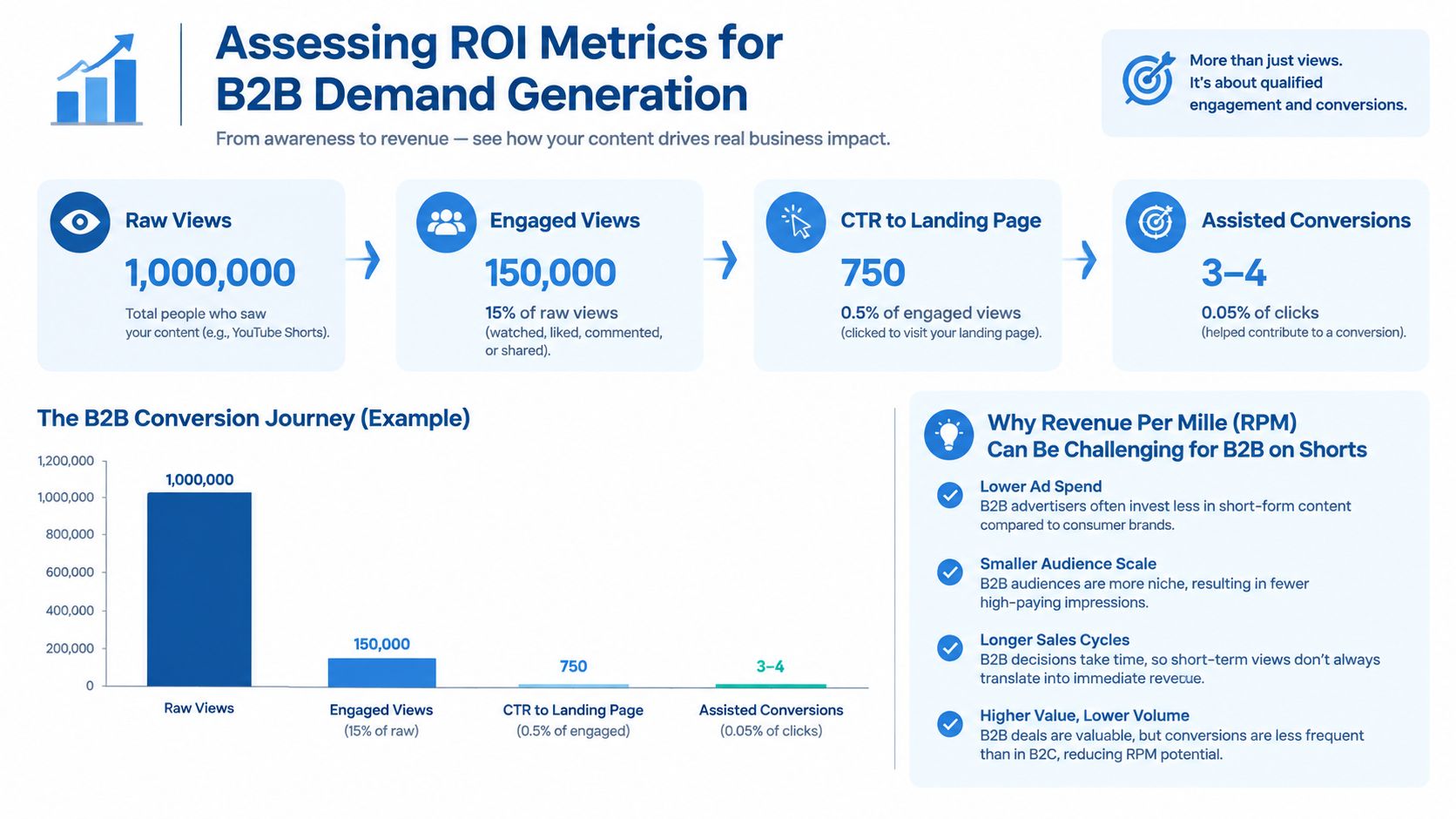
For B2B, the wrong way to judge Shorts is to stop at views. A video can rack up attention and still fail as a demand asset if it doesn't produce engaged views, clicks, branded search lift, or assisted conversions. That matters even more now because YouTube changed how it counts Shorts views, so a view can include a start or replay, while monetization and Partner Program eligibility still depend on engaged views (ShortsIntel). Top-line reach can therefore overstate real business value.
The metric stack that actually matters
A B2B Shorts campaign should be read from the bottom of the funnel upward:
- Engaged views, not just starts.
- Click-through to a landing page, especially to a problem-specific offer.
- Assisted conversions, since many buyers won't convert on the first touch.
- Branded search behavior, which often captures the trust effect that Shorts creates.
That framework is more useful than RPM when the goal is pipeline. Recent multi-channel analysis found Shorts RPM at roughly 3–14% of long-form RPM in most niches, with many channels needing about 11,000–34,000 Shorts views to match the revenue from 1,000 long-form views (air.io). In other words, if you're selling services, software, or high-consideration offers, ad payout alone is usually the wrong scoreboard.
Bottom line: measure Shorts like a demand channel, not a creator dividend stream.
For paid distribution, a useful starting point is YouTube ads for Shorts, because intent-based promotion can help you separate pure entertainment reach from buyer-relevant exposure.
Why B2B teams misread the upside
Shorts can create the impression of scale faster than it creates trust. That's not a flaw if you treat it as a top-of-funnel asset, but it becomes a problem when teams expect immediate lead volume from every clip. The better test is whether each batch improves the quality of later traffic, the share of people who search for your brand, and the efficiency of downstream remarketing.
Tactical Pros and Cons of YouTube Shorts
Shorts is strongest as a discovery channel. As noted earlier, the format brings in viewers who have not subscribed yet, which matters for B2B founders trying to reach buyers before category language is established. That makes Shorts useful at the top of the funnel, especially in crowded markets where the first job is to get noticed by the right problem-aware audience.
The upside for founders
Shorts lowers the cost of consistency. A single founder interview can become several clips, which reduces the editing load that often stalls content programs. It also creates a faster feedback loop for testing hooks, claims, and positioning before a team spends more time on long-form assets or paid distribution.
For teams that need to generate AI shorts fast, that production speed can matter as much as reach. Its core value is not just volume. It is the ability to iterate on messaging with a low-friction workflow and see which ideas earn follow-on attention.
The downside you can't ignore
The main trade-off is channel interference. Research on YouTube Shorts found that adding short-form content later on a channel was associated with weaker long-form engagement on the same channel (arXiv). For a mixed-format strategy, that points to role separation. Shorts should handle discovery and recall, while long-form should carry depth and conversion.
Monetization is another constraint. Shorts usually produce much weaker ad revenue than long-form, so teams that judge the format by RPM alone will likely undercount its value. There is also audience-quality drift, because recommendation systems can favor broad engagement and entertainment over niche problem-solving. For B2B, that means a clip can earn attention without producing buyer-adjacent attention.
| Pro | Con |
|---|---|
| Reaches people who do not already follow you | Can pull attention away from long-form if mixed carelessly |
| Supports rapid message testing | Often weak on direct monetization |
| Makes founder visibility easier to repeat | Can favor broad entertainment over niche education |
The practical question is whether your channel setup keeps each format on its own job. If Shorts is assigned to discovery, and long-form is reserved for explanation and conversion, the format can support B2B growth without distorting the rest of the funnel.
Audience Fit and Targeting for B2B Founders
Shorts fits some B2B ICPs better than others. The format works when a buyer can grasp the problem from a short explanation and when repeated exposure helps them trust your point of view. It works poorly when the offer needs a long evaluation before the buyer can even name the problem.
Where the audience is large enough to matter
The audience base is large enough to justify testing in major markets. That scale makes Shorts useful for founders selling across regions or trying to learn which message carries across markets.
What matters for B2B is not just reach. Shorts is discovery-first, and that makes it suited to reaching people before they know your category language. Since a large share of views come from non-subscribers (Kapwing), the format can place a founder's message in front of buyers who have not followed the channel yet.
How to think about fit
Shorts is strongest when your ICP responds to:
- Problem-first hooks, where the viewer already feels pain.
- Founder voice, because trust is part of the conversion.
- Simple claims that can be shown quickly, rather than explained in a long webinar.
- Search-intent targeting, if you are running paid clips against people researching the problem.
That last point matters for B2B buyers. A founder-led clip placed against active search intent can work differently from a broad organic post. It shows up closer to the moment of awareness, which is often where higher-quality attention begins.
Algorithmically, the format can still tilt toward broad engagement, so niche educational content needs tighter packaging than entertainment content. If your buyer only understands value after a detailed demo, Shorts should support the funnel rather than carry it.
Real World Examples of Founder Led Shorts Wins
The most useful way to think about Shorts is as a repeatable exposure engine. A founder doesn't need to become a creator. They need a system that turns one clear point of view into many lightweight touchpoints. That's why founder-led programs tend to work better than generic brand clips, the audience hears a human voice, not a polished content machine. CrowdTamers' founder-led marketing approach is built around that idea.
Three patterns that show how it can work
A SaaS founder can use weekly tip clips to make the category easier to remember. In practice, that usually means one recurring theme, one recurring format, and one clear point of view. The point isn't to entertain for its own sake, it's to make the brand easier to recall when a buyer later searches for a solution.
An agency can use intent-targeted explainer Shorts ads to surface to people already looking for the problem. In that setup, the clip becomes a pre-sell asset. It frames the problem, establishes expertise, and pushes the buyer toward a landing page or consultation path.
A keynote speaker can turn behind-the-scenes clips into event sign-up fuel. The clip doesn't need to be the keynote. It only needs to signal authority, show momentum, and give the audience a reason to click through.
What matters most: the clip format should match the stage of intent, not the ego of the speaker.
The common thread across all three examples is not view count. It's reuse. Founder interviews, product demos, and short teaching moments can be edited into multiple assets, then tested across organic and paid distribution. That gives teams a way to learn which angle drives return visitors, which hook produces stronger downstream clicks, and which message deserves more production time.
For B2B founders, Shorts wins when the content system is built for iteration. A single clip rarely changes the pipeline. A sequence of clips, tested against a specific market, often does.
Conclusion and Next Steps for Your Strategy
YouTube Shorts is worth it when you use it as a top-of-funnel demand channel, not a direct monetization play. The strongest signals are reach, non-subscriber discovery, and downstream conversions, while the weakest signal is RPM. The format works best when Shorts and long-form each have a separate job, because mixed channels can blur performance and weaken longer-form engagement.
Start with one clear audience, one offer, and one founder voice. Then publish a small series, track engaged views and assisted conversions, and review whether the clips create branded search or qualified traffic. If you want a disciplined rollout, pair the organic test with paid targeting and decide early whether the channel is earning more trust or just generating noise.
If you want a broader operating model for this, paid organic isn't an oxymoron, it's the only smart play in 2026.
CrowdTamers helps B2B founders turn founder voice into a repeatable content and demand system, with Shorts, clips, and targeted distribution tied to measurable funnel outcomes. If you're deciding whether YouTube Shorts fits your growth plan, visit CrowdTamers to see how the team structures founder-led campaigns, paid distribution, and conversion-focused testing around the channel.