
Most founders don’t have a content problem. They have a founder-time problem.
They know what they believe. They know which customer problems keep showing up. They’ve got opinions about the category, the product, and the advice that makes their customers’ lives worse. Then they open LinkedIn after a long day and try to turn all of that into a post.
That system doesn’t last, because the founder’s calendar always wins in the end.
Founder-led marketing works when the founder supplies the judgment and someone else builds the publishing machine around it. The founder records the raw material. An operator turns it into useful posts, short videos, landing pages, and paid creative. The company measures whether buyers move closer to a conversation.
That is a much better use of founder time than asking a busy executive to become a full-time content creator.
What founder-led marketing means
Founder-led marketing puts the founder’s point of view at the center of the company’s public presence. It doesn’t mean the founder has to write every caption, edit every clip, or answer every comment.
The founder supplies the parts nobody else can fake, including:
- What customers keep getting wrong.
- Which category advice you reject.
- Why you made a product decision.
- What failed before you found a better approach.
- What you believe will happen next.
The team then records, edits, packages, publishes, tracks, and distributes that material, so the founder isn’t rebuilding the same piece from scratch every week.
Think of the founder as the company’s chief trust officer, not its spokesperson. A spokesperson repeats approved messages. A founder puts a reputation behind a view and gives buyers a person to evaluate.
That distinction matters in B2B because the buyer’s usually taking a risk. They may have to defend the purchase to a boss, security team, finance department, or group of people who were perfectly happy with the old system. A generic company message doesn’t help much. A founder who can explain the problem in plain language gives the buyer something they can carry into that internal conversation.
Why founder-led marketing works for B2B startups
Early-stage B2B companies have a trust problem before they have a reach problem. Buyers don’t know the company. They don’t know whether the product works in their environment. They don’t know whether the team will still answer the phone after the contract is signed.
Founder visibility helps because it gives the buyer more than a logo and a list of features. It shows how the company thinks.
Bain’s analysis of S&P 500 companies found that founder-led companies outperformed non-founder-led peers by 3.1x in total shareholder returns from 1990 to 2014. The advantage was 1.4x after technology companies were removed from the sample (Bain evidence referenced in this founder-led marketing analysis).
That research is about company leadership and shareholder returns, not a promise that posting on LinkedIn will grow your startup. It does support a narrower point: founder involvement can matter when it changes how the company makes decisions and how people see it.
The trust case for thought leadership is also measurable. Edelman and LinkedIn’s 2024 B2B Thought Leadership Impact Report found that 73% of B2B decision-makers considered thought leadership a more trustworthy way to assess a company’s capabilities than marketing materials. The report also found that 77% were more likely to do business with a company whose leadership is active online, according to a summary of the findings (report findings summarized for founder-led marketing).
Those numbers don’t mean every founder needs to publish every day. They mean the person behind the company can be part of the evidence buyers use to judge the company.
Founder content compounds
A single post disappears quickly, but a body of useful opinions gives buyers something they can recognize when they encounter the company again.
After ten videos, a buyer may know what you believe about implementation. After twenty, they may understand how you think about pricing, hiring, or the category itself. They don’t have to agree with every point. They’ve got to remember what you stand for.
That memory helps when they later see an ad, receive an outbound message, or land on your site after searching for a problem. The company isn’t starting from zero.
Founder content gives sales a warmer start
A sales conversation goes better when the buyer already understands the problem your company is trying to solve. Sales can spend less time explaining the category and more time learning whether the product’s a fit.
This won’t remove procurement, technical review, or budget objections. It can make those conversations more specific.
The same logic appears in a multi-touch approach to building trust in B2B sales. Buyers need repeated signals before they take a risk. Your reporting should show those signals instead of pretending that the last click created the whole deal.
Founder content can protect paid media spend
Paid ads are a distribution layer. They aren’t a substitute for a point of view.
Use organic founder content to find the ideas that make the right buyers stop. Then put paid spend behind the strongest ideas. Weak angles can die as posts instead of consuming a month’s ad budget.
The test is downstream behavior. Look at qualified conversations, sales acceptance, pipeline, and revenue influence. A large view count with no buyer response is a distribution result, not a business result.
Founder-led marketing is different from three nearby tactics
Corporate content
Corporate content speaks as the company. It can be accurate and polished, but buyers often have to trust the company before the company has shown them much to trust.
Founder content gives the message a person, a history, and a point of view.
Influencer marketing
Influencer marketing borrows somebody else’s audience and credibility. That can work for a campaign. It can also disappear when the contract ends or the influencer moves to another category.
Founder-led marketing builds an asset the company keeps.
Machine-written content
Tools can help with research, editing, transcription, and repurposing. They can’t supply lived experience. If the founder doesn’t contribute the judgment underneath the content, it becomes a collection of generic claims with a founder’s name attached.
Cheap words aren’t the same as judgment. The buyer can tell.
The founder supplies insight. The team runs the system.
One of the worst ways to run founder-led marketing is to make the founder responsible for every step, because the program will stop whenever the founder gets busy.
The founder records the interview, picks the clips, writes the captions, adds the links, schedules the posts, checks the comments, launches the ads, and builds the report. That creates another executive bottleneck, and it means the program stops whenever the founder gets busy.
The founder should provide:
- The opinion.
- The customer story.
- The product reasoning.
- The specific example.
- The final approval.
An operator should handle production:
- Interview preparation.
- Video editing and captions.
- Post formatting.
- Landing-page links and tracking.
- Publishing and paid campaigns.
- Weekly reporting.
The operator can remove repetition and tighten structure. They shouldn’t replace the founder’s language with polished sentences nobody would say out loud.
If a founder wouldn’t say it in a customer conversation, it shouldn’t appear in the founder’s content.
Five benefits that matter for B2B startups
1. Trust that builds over time
Competitors can copy your colors, your ad format, and your feature language. They can’t quickly copy a founder who has spent a year explaining a category from a consistent point of view.
One analysis of the Edelman and LinkedIn research found that 75% of decision-makers had researched a product or service they hadn’t considered after seeing a piece of thought leadership. The same summary reported that 55% had used thought leadership to assess organizations they were already considering hiring (founder-led growth and thought-leadership findings).
2. Better sales conversations
Founder content can answer the first round of category questions before the demo. It can also surface objections that a product page avoids.
A founder explaining why an implementation failed is more useful than a page that says implementation is easy. A founder explaining which companies should not buy the product gives a serious buyer more confidence than another paragraph about flexibility.
3. Better use of paid acquisition
Organic content gives you a low-cost place to test ideas. Paid distribution gives the strongest ideas more reach.
Keep the two connected. If a clip performs well with a broad audience but creates no qualified traffic, don’t call it a winner. If a clip produces fewer views but better conversations, it may deserve more spend.
4. A clearer hiring signal
Strong candidates want to understand how a company thinks before they join it. Founder content shows product judgment, customer standards, and the kind of work the team values.
Someone who has followed the founder’s thinking arrives with better context than someone who found the company through a generic careers page.
5. A stronger answer to “Why you?”
As categories mature, feature lists start to look alike. A founder who explains the problem, the tradeoffs, and the limits of the product gives sales something better than another table-stakes comparison.
That doesn’t justify arbitrary pricing. It gives buyers a reason to see the company as more than an interchangeable vendor, even when the feature lists look similar.
A repeatable founder-led content framework
The system should be boring to run, which is a good sign when you’re building a dependable source of founder material instead of waiting for one viral post to rescue the quarter.
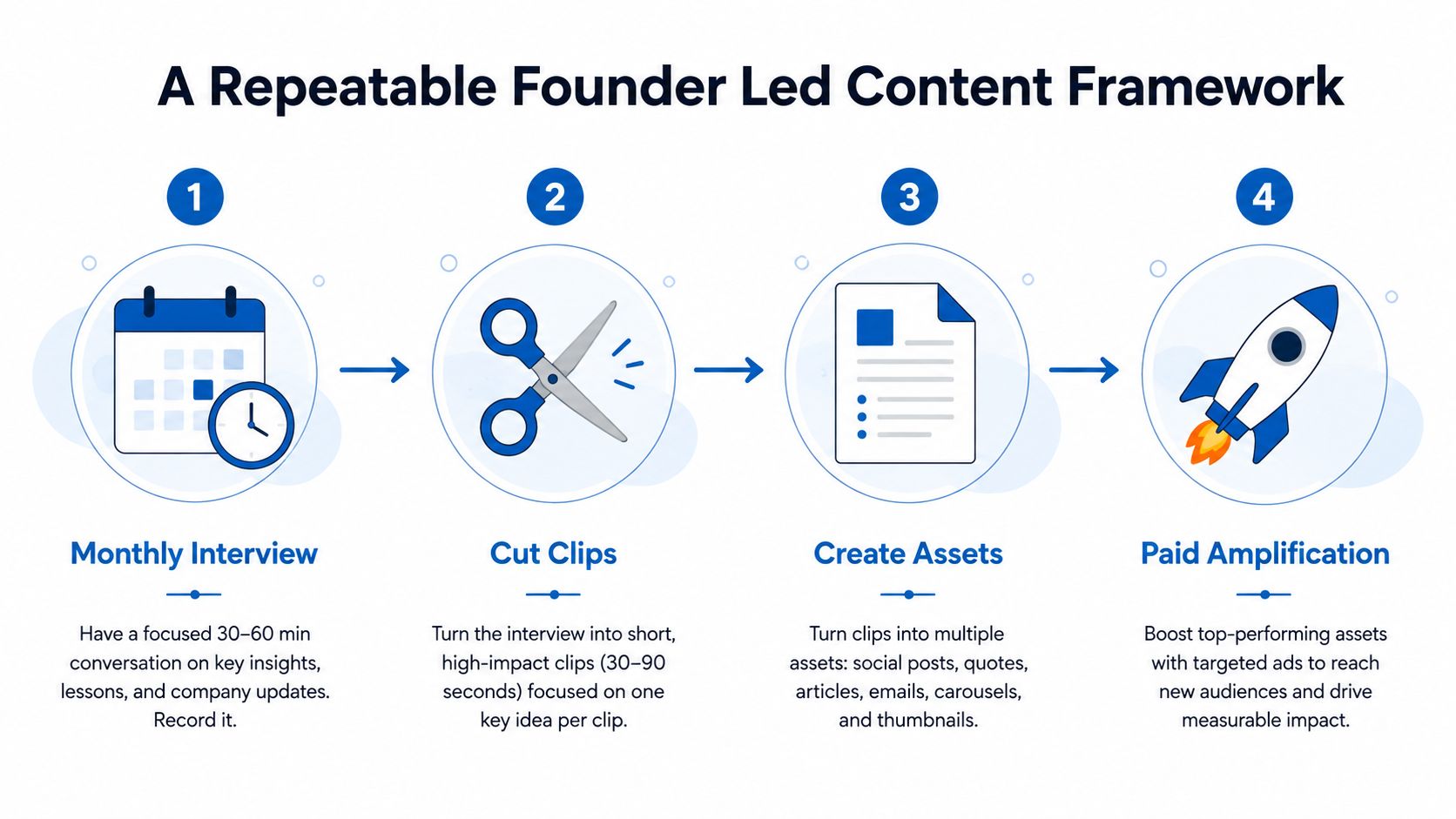
1. Record one monthly interview
Book a 60-minute founder interview every month. Use a shared document with customer questions, sales objections, support patterns, and recent deal notes.
The interviewer should interrupt vague answers and ask for the example behind the opinion. Prompts can include:
- What do buyers misunderstand before they speak with us?
- Which common recommendation in this category would you reject?
- What did a recent customer teach us?
- Which product decision looked wrong from the outside but made sense internally?
- What failed, and what would you do differently now?
The interview becomes one long-form video or podcast conversation. It also becomes the source for the next month’s short-form work.
2. Cut the interview around buyer problems
Turn the conversation into eight to twelve short videos, four LinkedIn posts or carousels, three quote graphics, and two newsletter sections. Each piece should answer one question.
Don’t make every asset a summary of the interview. A buyer opens the clip while trying to solve a problem, not while searching for your interview.
Short-form video can fit this model well. Research and production guidance often puts strong B2B retention in the 45-to-75-second range, with many useful clips staying under 90 seconds (short-form B2B video research).
3. Give every clip a search intent
Don’t title a clip “Founder thoughts on growth.” Use the buyer’s language:
- Cold email deliverability fix.
- B2B churn benchmark.
- How to choose a product-led sales motion.
- Founder-led marketing for B2B startups.
Match the spoken promise, title, description, ad audience, and landing page to the same question. Someone who watches a deliverability explanation shouldn’t land on a generic homepage.
4. Add paid distribution after the message works
Use YouTube Shorts ads or LinkedIn ads to distribute clips to relevant audiences, and give each creative one landing page, one promise, and one CTA so the buyer doesn’t have to work out what happens next.
Retarget people who’ve watched or engaged with a relevant offer. Don’t send them a menu of unrelated actions. Continue the conversation they started with the clip.
A 70/30 budget split can work as an operating rule: send 70% toward clips that have shown qualified response and keep 30% for new angles. The split is a starting point, not a universal performance guarantee.
Refresh the ads every two weeks and publish three clips a week. Review the quality of the resulting conversations instead of using views as the final score.
5. Keep the checklist visible
- Record: Hold the monthly interview.
- Cut: Produce the long-form asset and short clips.
- Tag: Assign each clip a query, audience, offer, and landing page.
- Publish: Distribute the content through the channels where the buyer spends time.
- Test: Put controlled paid spend behind the strongest ideas.
- Review: Track qualified conversations and pipeline influence.
The metrics that separate reach from revenue
Views, followers, and CPM can help explain distribution, but they can’t tell you whether founder-led marketing is helping the business or merely filling a dashboard.
Review these numbers every Monday:
Branded search
Track searches for the founder’s name, the company name, and the product name. Search growth can show that content is creating memory. Compare it with qualified inquiries and CRM activity before you claim a revenue effect.
Qualified conversations
Add a CRM source called “founder content.” Record self-reported mentions, tracked links, campaign exposure, and sales notes in the same opportunity so you can see how the account found you.
For a seed-stage company, eight to fifteen founder-content qualified conversations per month can be a useful internal target. It isn’t an industry benchmark. Adjust it to your deal size, sales capacity, and buying cycle.
Video retention
Track how many viewers watch at least 70% of a clip. A rate above 35% can be a useful testing benchmark for intent-focused clips, but retention still needs to connect to qualified traffic and conversations.
A clip that holds attention and produces no commercial response may be educational without being relevant to the buying problem.
Assisted pipeline
Record deals where founder content appeared at two or more touchpoints before close. Save the content URLs, dates, campaign IDs, and touchpoint type.
Last-click reporting will miss much of this. That doesn’t mean you should give every deal to content. It means you need a record of the path buyers took.
| Metric | What it tells you | Review |
|---|---|---|
| Branded search | Whether buyers remember the company | Weekly direction |
| Qualified conversations | Whether sales accepts the interest | Monthly count and source |
| Video retention | Whether the message holds attention | By clip and audience |
| Assisted pipeline | Whether content appears in active deals | By opportunity and touchpoint |
The number I would put at the center of the dashboard is qualified sales opportunities sourced or assisted per hour of founder time.
That forces the program to respect the founder’s calendar.
Five mistakes that kill founder-led marketing
Mistake one: content becomes a brand exercise
The team publishes attractive clips with titles such as “Thoughts on SaaS growth.” Sales can’t use them because nobody knows which buyer problem they address.
Fix: Give every clip one search intent, one audience, one problem, and one next page.
Mistake two: the team posts everywhere
Separate ideas for LinkedIn, YouTube, email, and the blog create exhaustion. The founder repeats the same conversation while the operator rebuilds everything from scratch.
Fix: Record once and cut eight to twelve pieces. Adapt the hook and format by channel, but keep the underlying argument consistent.
Mistake three: paid ads have no hook testing
The team finds one acceptable clip and puts the whole budget behind it. When performance drops, they blame the channel.
Fix: Reserve 30% of the budget for new hooks. Test the opening, buyer problem, proof point, and CTA separately.
Mistake four: the founder becomes the only operator
The founder approves every caption, edits every clip, tags every campaign, and writes the report. The program stops whenever the founder gets busy.
Fix: Give one operator ownership of production, publishing, tracking, and reporting. The founder should remain the source of judgment, not the person moving files between folders.
Mistake five: reach replaces pipeline
The team celebrates a view spike while sales sees no change in qualified conversations.
Fix: Add the founder-content source field to the CRM, record self-reported influence, and review sourced and assisted sales opportunities each month.
The most common failure is a missing connection between the clip and the next step. Attention doesn’t become pipeline by itself.
Templates you can use this month
The monthly interview sheet
Create five fields in a shared document:
- Buyer question: What does the prospect ask before they understand the category?
- Founder position: What do you believe that competitors avoid saying?
- Evidence: Which customer pattern, product decision, or failure supports the view?
- Repeatable sentence: What line should a buyer be able to repeat internally?
- Next step: Which resource or page should the viewer see next?
Start with: “What do most buyers get wrong about this?” Then ask for the example. Finish with: “What should a team do on Monday?”
The clip naming system
Use a naming convention the whole team understands:
INTENT_FORMAT_AUDIENCE_HOOK_VERSION
For example:
COLD_EMAIL_DELIVERABILITY_SHORTS_REVOPS_STOP_BEFORE_SENDING_V1
For each clip, record the query, opening line, founder answer, length, destination page, CTA, UTM campaign, and CRM source value.
The search-intent ad chain
Set up the campaign as one connected path:
Query: “B2B churn benchmark”
Video hook: “A churn number without segment context can mislead your board.”
Landing-page headline: “Interpret B2B churn by segment before changing the product.”
Offer: One benchmark worksheet.
Qualifying question: “Which customer segment are you evaluating?”
CTA: “Get the worksheet.”
CRM source: Founder content, B2B churn benchmark, Shorts.
Every part of the chain should answer the same buyer question. If the clip and page make different promises, fix that before increasing spend.
Your next move as a founder marketer
Book one 60-minute interview, bring five customer questions and three recent sales objections, record the conversation, and cut ten clips that each have one buyer problem, one destination page, and one CTA.
Then measure the only thing that protects the program from becoming theater: qualified sales opportunities sourced or assisted per hour of founder time.
The founder doesn’t need to become an influencer. The founder needs to stay visible, specific, and accountable to the numbers. Let an operator run the machinery. Keep the judgment at the source. Stop scaling any asset that can’t explain which buyer problem it addresses.
CrowdTamers helps B2B founders turn monthly interviews into founder-led Shorts, written content, and targeted campaigns tied to measurable funnel performance. If you want the production, intent targeting, landing-page wiring, and reporting handled without turning your calendar into a content factory, visit CrowdTamers.