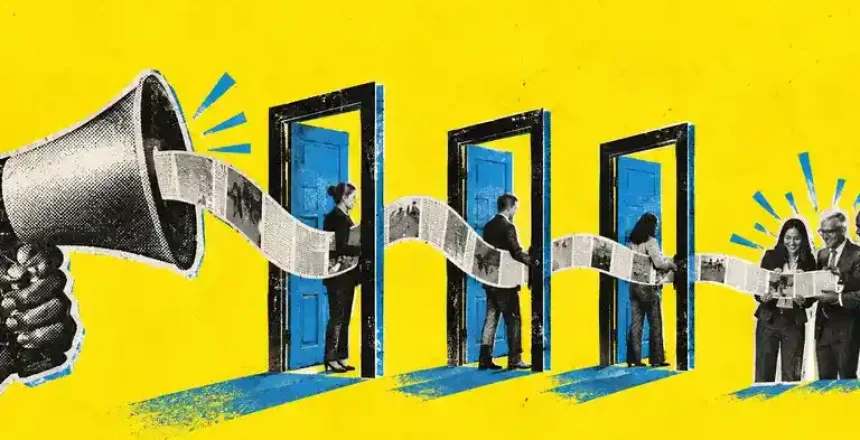
Content and story turn into revenue when buyers can repeat your point after they leave the page. That’s the work. Not a pile of assets. Not a brand voice document that never reaches a sales call. A useful message has to survive a founder post, an email, a demo, and the internal conversation where somebody asks, “Why are we changing this now?”
Most B2B teams split those jobs. Content gets assigned to production. Story gets assigned to branding. The result is busy publishing with no sentence a buyer can carry into the next meeting. Buyers don’t need more noise. They need language they can use.
Content is the thing you publish. Story is the pressure that makes it matter. Put them together and you give the buyer a problem worth naming, a point of view about it, and a way to explain why the old habit costs them money or time. If buyers can’t say it back, it won’t travel.
Content and story need one sentence that travels
A content calendar isn’t a message. It’s a set of delivery dates, and it cannot tell a buyer why the work deserves attention while every competing priority is asking for their time.
The story starts earlier. It starts with a hard view of the buyer’s current situation. For example, a revenue team that spends every forecast meeting arguing about whose spreadsheet is right doesn’t need another list of reporting features. They need a clearer way to describe the cost of running the business through competing versions of the same number.
Once that sentence is clear, each piece of content can do a different job without wandering off. A founder video can name the frustration. A longer post can explain why the usual fix falls apart. A sales page can show the method. A customer conversation can test whether the language sounds like something buyers already say. It doesn’t have to repeat the same paragraph.
That’s why the distinction matters. Content creates opportunities for contact. Story gives those contacts continuity.
Our work on building a marketing engine from content follows the same rule: publish around a commercial belief, then keep the belief visible across the places a buyer will encounter you. If every asset starts from scratch, the audience has to start from scratch too. You can’t build recognition by resetting it every week.
Start with the buyer’s expensive normal
Good B2B stories don’t need invented drama because the buyer already has enough of it in the recurring work that makes an ordinary day harder than it has any right to be.
Look for the ordinary thing that wastes time, creates risk, or makes a team look foolish in front of its own leadership. That might be a handoff that breaks every Friday afternoon, a procurement process full of mystery, or a support queue that keeps teaching customers the same workaround. You don’t have to invent the pressure.
Then make a claim about it. A claim has teeth. “We help businesses grow” doesn’t. “Your planning process can’t be trusted if every department owns a different forecast” does.
The vendor is usually more useful as the guide than the hero. The buyer has the problem, carries the consequences, and has to defend the decision. Your product, service, or method belongs in the explanation of how the situation changes. You don’t get to skip their point of view.
This is also why a feature list rarely carries a campaign by itself. Features answer “what does it do?” A story answers “why is this problem expensive enough to act on now?” Both questions matter. They aren’t interchangeable.
Pick a structure, then keep using it
Teams burn time trying to find a brand new framing for every post, although a campaign gets easier when the story structure stays put while the evidence changes and the team uses the same belief to do a different job in each format. You don’t need a new slogan for each asset.
When buyers already know the problem
Use a simple movement: current condition, method, changed condition. This works for case studies, late-stage pages, and sales material because the reader doesn’t need a long lesson before they can evaluate the offer.
Don’t manufacture a performance number to make this work. If you have approved customer evidence, use it carefully. If you don’t, describe the before and after in plain operational terms.
When buyers feel the pain but have not named it
Show the work they are doing now, then give them a better way to interpret it. The bridge should be practical. “Stop using spreadsheets” is not a bridge. “Give every team the same weekly operating view before you automate the reporting” is closer to one.
This structure works well in nurture emails and founder posts because it gives readers room to recognize themselves before you ask for anything. It won’t force a decision before the reader sees the problem.
When the audience is still cold
Start with a familiar incident. A founder can describe the meeting, process, or customer complaint that changed their mind. Then explain the observation that made the old approach look untenable.
Short-form video can help here if it carries an actual thought rather than a slogan. Google’s discussion of YouTube Shorts and short-form video research is useful context for teams choosing where a short founder point of view might live. The channel doesn’t create the idea for you. It only gives the idea another chance to meet the right person.
For the production side, a content marketing framework can keep formats, owners, and timing from becoming a mess. It shouldn’t sand the message down until every post sounds like the same agency wrote it.
Make the story survive the handoff
A founder can say something sharp on camera and still lose the point by the time it reaches the sales deck, because it won’t survive if each team rewrites it from memory and keeps only the piece that suits its own template.
That’s a handoff problem. Someone turns the observation into generic copy, someone else pulls only the features, and the buyer meets three versions of the company in one week.
Give the team a small message sheet. It doesn’t need more than four lines:
- The buyer’s expensive normal.
- The belief you want them to remember.
- The proof you can honestly use.
- The first action that makes sense if they agree.
That’s enough to guide a post, a sales email, and a call opener, but it also gives you a test: ask a salesperson, a founder, and a recent customer to explain the company’s point of view without looking at the sheet. If they tell three different stories, you’ve got an internal distribution problem before you have an audience problem.
Samuel Woods’ piece on a single core story makes a related argument: differentiation becomes easier when the business can hold one central tension in view. The language doesn’t need to be identical everywhere. The belief does.
Founder-led content works when it starts with a useful conversation
Founders shouldn’t be asked to invent a new opinion on command every Tuesday, because that produces vague advice and a lot of visible discomfort for people who have useful experience but no interest in performing a personal brand.
Record a conversation around one customer problem. Ask what made the founder distrust the normal answer, what they saw instead, and what a buyer can change this week. Then pull one long argument, a few short moments, and the sales language that came out naturally.
That’s closer to how a founder actually thinks. It also leaves room for the details that make a point believable: the awkward handoff, the meeting that went nowhere, the recurring workaround nobody wants to own. Those details don’t come from a calendar.
Our founder-led marketing work is built around that kind of source material. The founder provides the conviction and context. The content process keeps the point intact as it moves into other formats.
Teams exploring advertorial-style education can also use Landra’s guide to creating an AI-generated advertorial as a production reference. Keep the reader’s situation at the center. Any format turns slippery when the message starts admiring itself. It shouldn’t need hype to hold attention.
Content cannot stop when the contract is signed
A buyer who was persuaded by a clear point of view shouldn’t enter onboarding and meet a different company. The same story can make implementation easier: remind customers what problem they came to solve, explain why the process asks them to change a habit, and connect early wins to the promise that brought them in.
That doesn’t mean repeating the launch copy word for word. It means preserving the thread. The work after the sale should make the original decision look smarter, not make the customer reconstruct it from help articles and feature tours.
For a first pass, choose one buyer problem. Write the belief in one sentence. Build one longer piece around it, then reuse the same tension in a founder clip, a sales follow-up, and an onboarding touchpoint. Watch what buyers repeat back. Their language will tell you whether the story has started to travel. If they can’t repeat it, keep working.
Messages turn into revenue when they keep their shape long enough for somebody else to carry them into the meeting where the next decision gets made.